Publisher ID:
946
Our code:
MC-HR-POC-2014-04-11-3/3
Country:
Publisher:
Croatian Post
Design:
Sabina Rešić
Printing:
Zrinski d.d.
Stamp value:
3,10 HRK
Date of stamp issue:
Cancelled:
Theme:
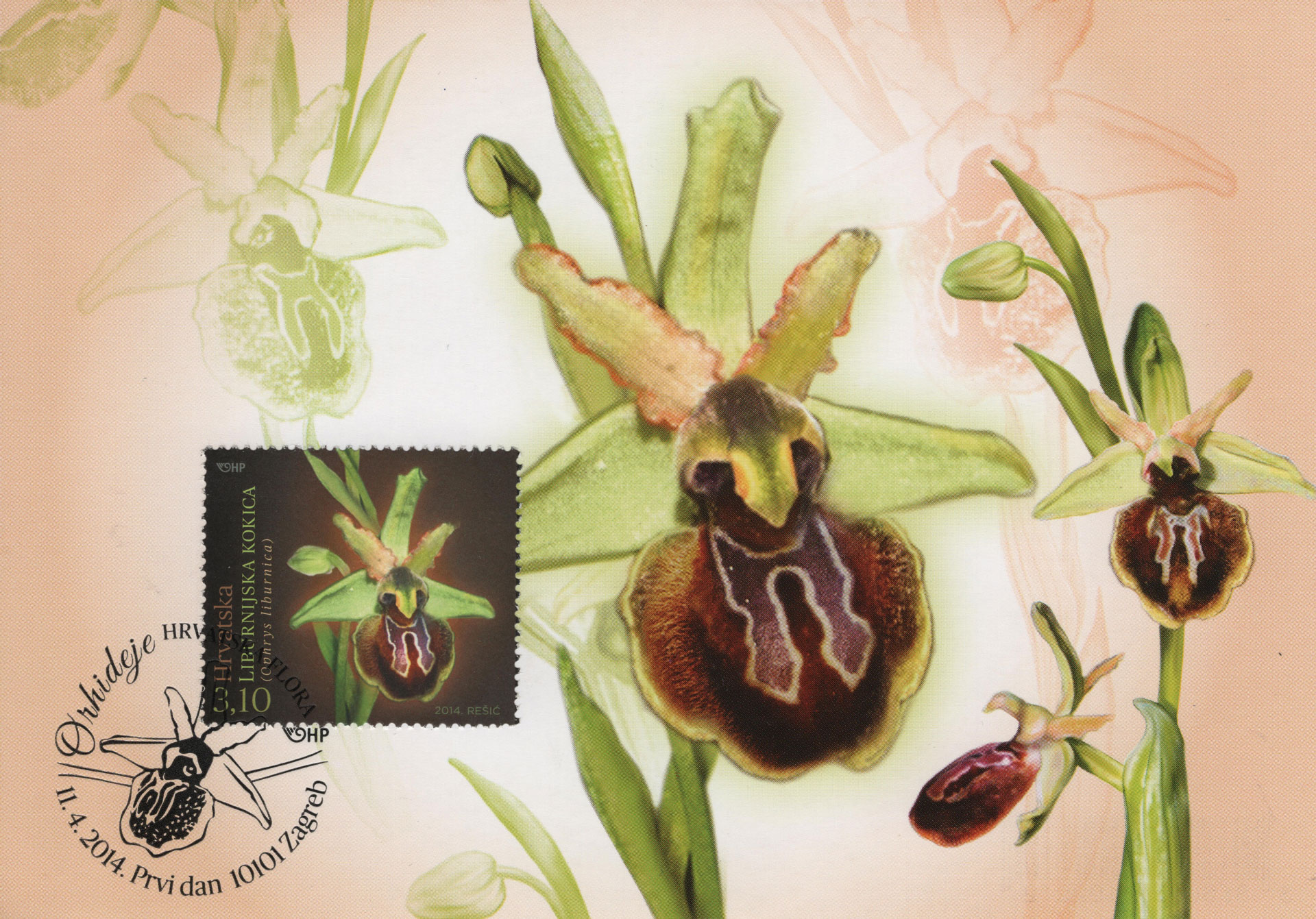
Flora of Croatia - Endemic orchids
In the member's collection
Together with several other related, endemic taxa, the Liburnian Popcorn (Ophrys liburnica) belongs to the group of early-flowering Popcorns with small flowers in the wide family circle of the Spider Popcorn (O. sphegodes). Popcorn spiders belong to the best-known, most widely distributed, but also the most variable species of the Kaćunovka family. They are spread almost all over Europe, including numerous subspecies, varieties and crosses of local character. The Liburnian Popcorn is one such Illyrian-Adriatic stone-endem, which blooms already in March on a small number of sites along the Croatian coast, from Istria to Korčula. It was described on specimens collected in 2002 on the island of Cres. It grows up to 30 cm in height. The flowers develop singly or in several, in a loose bloom. The three outer petals of the flower are usually greenish, while the inner ones can be more strikingly colored. The honey lip is dark and hairy, with a bare, blue pattern (mirror) in the shape of the letter "H" and false "eyes", which contribute to the appearance of the insect. The scientific name Liburnian popcorn comes from Latin. adjective liburnicus derived from the name of the Illyrian maritime people Liburna, who inhabited the northern Adriatic coast as early as the 9th century BC. It is one of the common characteristics of spider's webs, including Liburnia's, that their flowers completely lose their color immediately after fertilization, becoming unsightly green and unattractive to pollinators. Cucumbers - the largest and most evolutionarily diverse plant family on Earth, with an incredible almost 900 genera and more than 25,000 species - in Europe are on the ever-growing list of plants whose survival is uncertain. And the number of populations of all types of poplars has decreased in recent decades, mainly due to the fragmentation and disappearance of habitats (rocky grasslands, low open thickets, abandoned crops), which grow into forest.